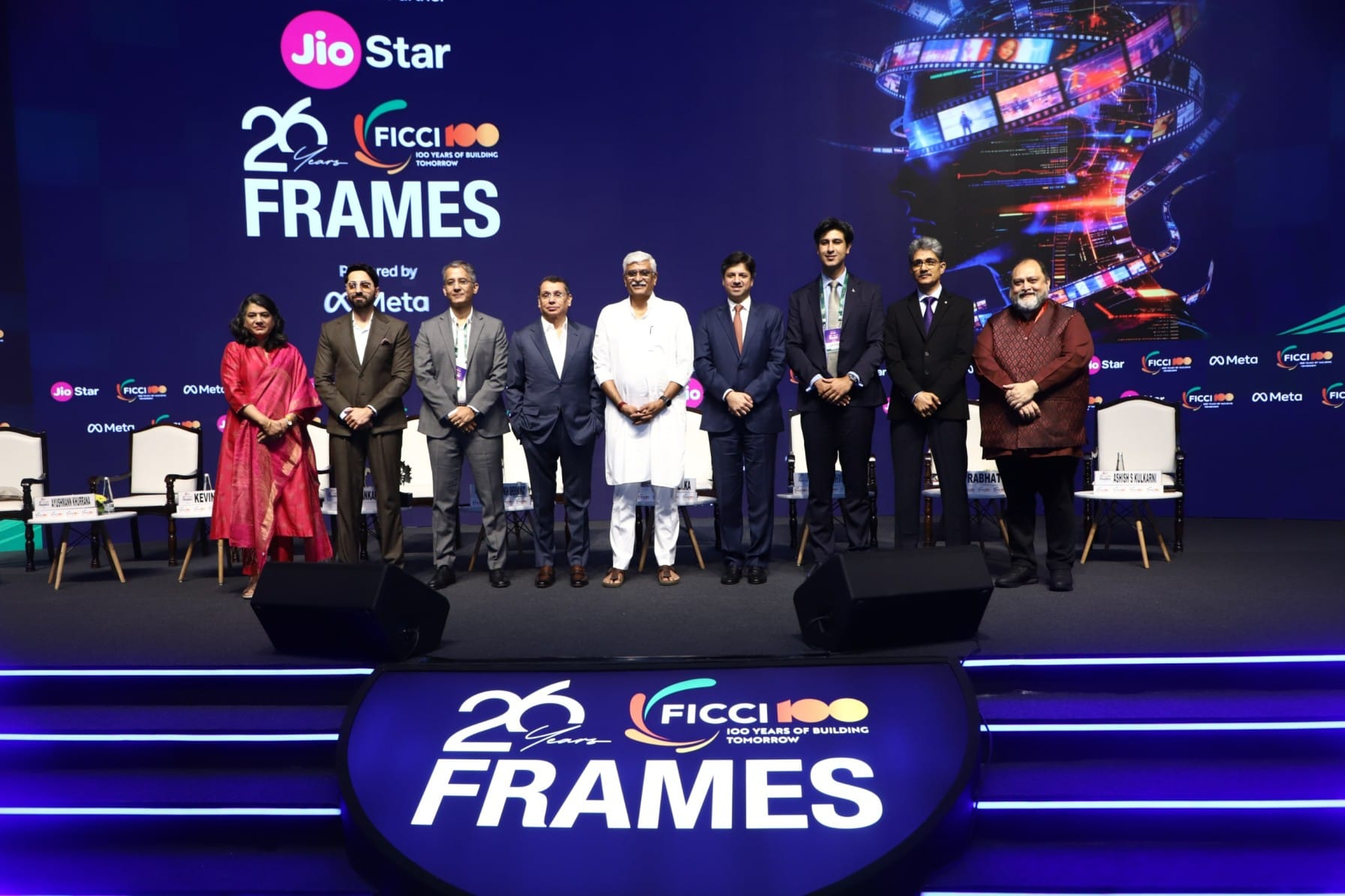
At the inaugural session of FICCI FRAMES 2026 in Mumbai, the Union Minister of Culture and Tourism highlighted India’s creative capital, original intellectual property, human creativity and the growing role of AI and emerging technologies in the media and entertainment economy.
Mumbai, September 29, 2026: India needs to move beyond being one of the world’s largest audiences and content markets to become a global leader in content creation and creativity, Union Minister of Culture and Tourism Gajendra Singh Shekhawat said at the inaugural session of FICCI FRAMES 2026 in Mumbai.
Addressing the 26th edition of the flagship media and entertainment convention at the Grand Hyatt, Mumbai, Shekhawat placed India’s creative strength, storytelling traditions and cultural diversity at the centre of the country’s next phase of media and entertainment growth.
The minister’s address came against the backdrop of this year’s FICCI FRAMES theme, “India’s Media Moment: Creating Value in an Age of Infinite Content,” which focuses on how the industry can create sustainable creative and economic value as content expands across film, television, streaming, digital platforms, gaming, sports, advertising and emerging technologies.
From Content Consumer to Global Content Creator
Shekhawat argued that the next phase of India’s media opportunity cannot be defined merely by the scale of its audience.
India, he said, has “more than content, it has context” — a combination of cultural diversity, traditions and storytelling that represents what he described as the country’s creative capital.
He identified three broad shifts that India needs to pursue: moving from being primarily a content consumer to becoming a global leader in content creation; moving beyond the size of the Indian audience to building original Indian intellectual property; and creating stronger connections between the India represented on screen and the experience of travelling through the real India.
The third element, he noted, can allow storytelling to contribute to tourism while tourism, in turn, creates opportunities for local economies.
Shekhawat also pointed to a period of rapid technological change, arguing that human creativity must remain central even as artificial intelligence transforms how content is created and consumed.
He said the industry could see greater interest in content involving less AI intervention and fewer filters, with human-created work potentially gaining renewed value in the coming years. The challenge, he emphasised, is to embrace technological opportunity without allowing it to dilute originality, creativity and the human connection that builds audience trust.
AI, AVGC, XR and Gaming Expand the Creative Economy
The minister also highlighted the expanding role of AVGC, XR, gaming, virtual production and artificial intelligence as emerging languages of storytelling.
These technologies, he noted, can create new ways of presenting culture and history — from bringing ancient cities to life and offering immersive experiences to revealing the stories behind museum objects and enabling younger audiences to engage differently with cultural practices.
The larger opportunity, therefore, lies not simply in producing more content, but in building new creative ecosystems around technology, intellectual property and talent.
Government, Industry and Creators Share the Responsibility
The opening session also brought together policymakers and senior industry leaders to examine what India’s media and entertainment sector needs as it enters its next phase of growth.
Prabhat, Additional Secretary, Ministry of Information and Broadcasting, underlined the respective roles of government and industry, noting that while government can provide institutions, policy frameworks, platforms and international linkages, the creative economy is ultimately built by creators and the industry.
He stressed the need for greater investment in original Indian intellectual property and stronger support for new writers, creators, musicians, animators and game developers.
Ayushmann Khurrana, acclaimed actor and FICCI FRAMES Ambassador, brought the creator’s perspective to the conversation, pointing to the ability of a story originating in a small Indian town — and even a creator working with a phone — to find an audience anywhere in the world.
For Anant Goenka, President, FICCI and Vice Chairman, RPG Group, the next challenge is to convert India’s scale into lasting value while ensuring that Indian stories retain their identity.
“We should give Indian storytellers the confidence, capital, technology and reach to go global, without removing what makes their work Indian.”
Uday Shankar Honoured for Contribution to Indian Media and Entertainment
The inaugural proceedings also recognised veteran media executive Uday Shankar, Past President, FICCI and Vice Chairman, JioStar, with the FICCI FRAMES Lifetime Achievement Award.
The award was presented by Gajendra Singh Shekhawat in recognition of Shankar’s contribution and leadership in India’s media and entertainment industry.
Accepting the honour, Shankar reflected on the wider role of media in society, describing it as a force that shapes collective imagination, aspirations and visions of the future.
“Media continues to be a fundamental pillar of society.”
The award added an industry legacy dimension to an opening session otherwise focused heavily on what lies ahead.
Regulation, Investment and Creative Freedom
The conversation then moved towards the conditions required for India’s media and entertainment sector to innovate.
Kevin Vaz, Chair, FICCI Media & Entertainment Committee and CEO, Entertainment, JioStar, highlighted the emergence of new value pools and the need for an environment that gives innovation room to develop. He also pointed to the broadcasting sector’s longstanding call for regulatory forbearance and emphasised self-regulation and strong industry practices as important components of the industry’s next phase.
Arjun Nohwar, Co-Chair, FICCI M&E Committee and Managing Director – South Asia, Warner Bros. Discovery, focused on the ecosystem required to support creators and new ideas. His observations centred on creative freedom, technology, investment and the role of policymakers and regulators in responding to an industry that is changing in real time.
Together, the opening discussions underlined a common challenge: India’s creative ambitions will require not only talent and technology, but also the investment, policy environment and freedom needed to allow new ideas to develop.
What Day 1 of FICCI FRAMES 2026 Is Bringing to the Table
The opening day of FICCI FRAMES 2026, being held on September 29 and 30 at the Grand Hyatt, Mumbai, brings together policymakers, broadcasters, studio and platform executives, filmmakers, actors, creators, technology leaders and representatives from across the wider media and entertainment ecosystem.
The Day 1 conversations span the industry’s major pressure points and opportunities — from theatrical cinema and changing audience behaviour to broadcasting, streaming, creator-led content, AI, technology, sports and the future of India’s creative economy.
Among the industry voices associated with the Day 1 programme are Prithul Kumar, Joint Secretary – Broadcasting, Ministry of Information and Broadcasting; Avarna Jain, Vice Chairperson, Saregama India; Sriram Raghavan, filmmaker and screenwriter; Arun Srinivas, Country Director – India, Meta; Mukesh Chhabra, casting director, director and actor; Amol Parashar, Abhay Verma, Prasoon Joshi, Chairman, Prasar Bharati; Sanjog Gupta, CEO, International Cricket Council; Siddharth, actor; Suresh Triveni, director of Maa Behen; Abhijeet Singh Parmar, writer, creator and showrunner of Operation Safed Sagar; Maahi, actor and singer; Kumar Padmapani Bora, Commissioner & Secretary, Information & Public Relations Department, Government of Assam and Managing Director, Assam Tourism Development Corporation; and Vijay Vikram Singh, actor.
The Day 1 programme reflects the breadth of the FICCI FRAMES mandate, moving beyond cinema alone to examine the intersections between content, technology, platforms, sports, creators, policy, culture and commerce. Day 1 discussions have also included the changing economics and audience dynamics of theatrical cinema, with filmmakers and actors such as Ayushmann Khurrana and Sriram Raghavan participating in conversations around the big-screen experience.
The FICCI BAF Awards 2026, which recognise work across animation, VFX, gaming, comics, XR and AI, are also part of the wider FICCI FRAMES ecosystem, with the awards ceremony scheduled at Grand Hyatt Mumbai on September 29.
India’s Media Moment Is About Creating Value
The opening day of FICCI FRAMES 2026 therefore sets up a conversation that goes considerably beyond the volume of content India can produce.
The larger question is whether India’s enormous creative talent, cultural diversity, technology capabilities and audience scale can be converted into original intellectual property, globally relevant stories and sustainable value for the wider creative economy.
As AI and emerging technologies reshape the mechanics of storytelling, the message emerging from the inaugural session is that India’s competitive advantage may ultimately lie not in producing content faster, but in creating stories, ideas and experiences that carry an unmistakable Indian context — and can travel far beyond India’s borders.