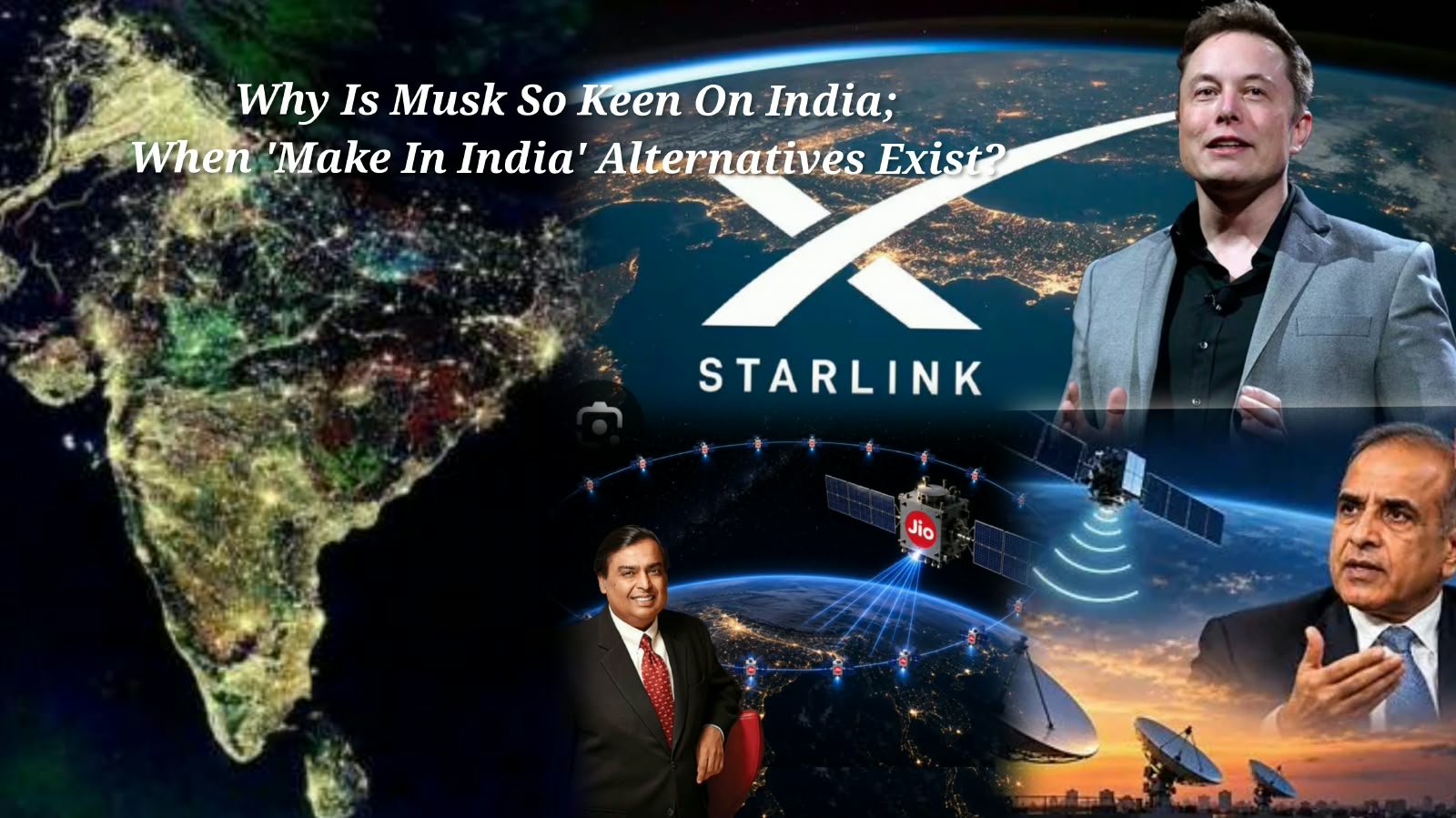
Elon Musk has triggered a political and corporate firestorm in India, publicly accusing local “oligarchs” of creating a “monopolistic chokehold” to block his satellite internet service, Starlink. The corporate standoff escalated dramatically into a highly charged public debate after opposition leader Rahul Gandhi responded to Musk on X, thrusting what was once a technical regulatory dispute into the center of national politics.
While Musk frames the delay as corporate gatekeeping, a deeper investigation reveals a much more pressing reality: India’s hesitation is fundamentally rooted in absolute national security, border protection, and growing skepticism over Musk’s own unpredictable track record.
The Spark: What Happened at the India Mobile Congress?
The recent flashpoint ignited at the India Mobile Congress (IMC) in New Delhi, where SpaceX executive Lauren Dreyer pitched Starlink’s readiness to deploy in India by 2027 to close the digital divide. Dreyer noted that Starlink has already built 20 gateway sites and hundreds of antennas across the country, custom-engineered to store Indian user data domestically.
However, hours after her announcement, Musk took to X to claim that “certain oligarchs” were blocking his entry, calling the regulatory pause a “crime against the people of India”. The Ministry of Communications swiftly pushed back against the discrimination narrative, explicitly stating that India’s satellite communications framework is fair and non-discriminatory, clarifying that all major players—including Jio and OneWeb—are undergoing the exact same mandatory security vetting.
The Starlink Dilemma: Weighing the Realities
The Pros (Musk’s Pitch)
- Rural Connectivity: Starlink promises 100% internet coverage to India’s most remote villages, deep forests, and mountainous terrains where traditional cell towers cannot reach.
- Disaster-Resilient Network: Low Earth Orbit (LEO) satellites remain operational during floods, earthquakes, or cyclones, providing critical backup communication for emergency services.
- Local Infrastructure: Starlink has proactively built 20 local gateway sites inside India to ensure domestic user data remains within the country’s borders.
The Cons (The India Reality Check)
- The Cost Paradox: Musk continuously pitches Starlink for underserved areas. However, India already boasts the lowest mobile data prices globally, hovering around $0.08 to $0.10 per GB. High-cost satellite hardware is a tough commercial sell against incredibly efficient terrestrial 4G/5G networks.
- Spectrum Allocation Controversies: Telecom operators strongly oppose giving away satellite airwaves via a fixed “administrative assignment”. They argue that it violates fair competition and demand an open auction process to protect massive local infrastructure investments.
- Pending Security Clearances: India’s intelligence agencies have kept Starlink’s final operating license strictly pending due to unresolved surveillance and intercept gaps.
National Security: Safeguarding India’s Vulnerable Borders
For Indian security agencies, satellite internet is viewed through a post-26/11 Mumbai attacks lens, an event that grimly highlighted the dangers of unmonitored satellite communication when terrorists used satellite phones to coordinate with handlers abroad.
Because LEO satellite terminals bypass traditional landline and cellular tower infrastructure, they present an entirely unique surveillance challenge. The Ministry of Home Affairs and intelligence agencies have left Starlink’s final clearance strictly pending until SpaceX can mathematically and operationally guarantee:
- Strict Geofencing: Ensuring that Starlink terminals purchased outside the country are completely dead inside Indian territory, and domestic terminals cannot function across international borders.
- Lawful Interception: Demonstrating robust, real-time monitoring and data-sniffing at all 20 local gateway sites so Indian agencies can legally track transmissions and immediately shut down prohibited content or rogue signals.
The stakes are highest along India’s sensitive border regions. Recent security incidents have vindicated the government’s caution: the Indian Army previously recovered an active Starlink receiver from a militant hideout in Manipur’s Imphal East district, likely smuggled over the porous Myanmar border where rebel factions actively use the network. Letting an external entity control a network capable of operating in dense border forests or high-altitude hills—completely immune to government-mandated internet shutdowns—presents an unacceptable risk to sovereign control.
The “Musk Factor”: Why Past Failures Make India Wary
Beyond technical compliance, a major roadblock is Elon Musk himself. Defense experts and academic studies—such as a notable report from Takshashila Institution—warn that relying on a foreign mega-constellation managed by a single, unpredictable billionaire introduces immense strategic vulnerability.
Musk’s past track record on the global stage does not inspire long-term confidence for India’s strategic autonomy:
- The Sovereign Overrides: During the Ukraine conflict, Musk unilaterally denied a Ukrainian military request to activate Starlink coverage near Russian-annexed Crimea to assist in a drone strike, effectively dictating military outcomes based on his personal geopolitical views.
- Smuggling and Rogue Use: Starlink has faced intense scrutiny over its inability to control its own hardware supply chain. Terminals have repeatedly been smuggled into blacklisted regions like Iran during civil unrest, and have been utilized by drug smugglers at sea to evade tracking infrastructure.
Desperation for Scale: The Pressure from Tesla and Domestic Competitors
Musk’s aggressive push for Starlink stems partly from compounding troubles across his broader empire. Tesla is facing severe global headwinds—marked by cooling EV demand, aggressive price cuts, and fierce competition from Chinese automakers—making it critical for Musk to unlock new growth engines.
However, India is far from an open playground. The country already has highly capable domestic alternatives waiting in the wings: Bharti Airtel’s Eutelsat OneWeb has secured essential clearances, while Reliance Jio’s JioSpaceFiber is actively preparing its own satellite broadband rollouts. Unlike Starlink, these domestic giants are fully integrated with India’s security ecosystem, heavily neutralizing Musk’s leverage.
The Big Question: Why is Musk So Keen on India When ‘Make in India’ Alternatives Exist?
The aggressive nature of Elon Musk’s relentless pursuit to enter the subcontinental market raises a crucial question for policymakers and citizens alike: Why is Elon Musk so aggressively keen on India considering its ultra-low data pricing, especially when robust “Make in India” options are already open to the government?
The answer lies in strategic scale and global dominance. Musk isn’t trying to match India’s dirt-cheap mobile rates; he is trying to secure a geopolitical foothold over the world’s most populous nation before sovereign domestic alternatives solidify their grip. For Musk, capturing India isn’t just a business expansion—it is a race against time to validate Starlink’s massive valuation against home-grown competitors like Airtel’s OneWeb and Jio’s space ventures, which enjoy direct compliance with Indian laws. By bypassing these local “Make in India” champions, Musk seeks absolute monopoly over space-based data, a prospect that inherently clashes with India’s vision for self-reliant, strictly monitored digital sovereignty.
Conclusion: Access Does Not Mean Success
Elon Musk looks at India and sees a golden gateway to 1.4 billion people to offset slowing growth in his other global ventures. But as many global corporations have learned the hard way, access does not mean success.
India’s regulatory delay isn’t a conspiracy of “oligarchs”—it is the calculated defensive posture of a sovereign nation. If Starlink wants to operate on Indian soil, it cannot bully its way in through social media posts. It must bow entirely to India’s domestic security agencies, ensuring that its vast constellation remains a verifiable asset, rather than a sovereign liability.