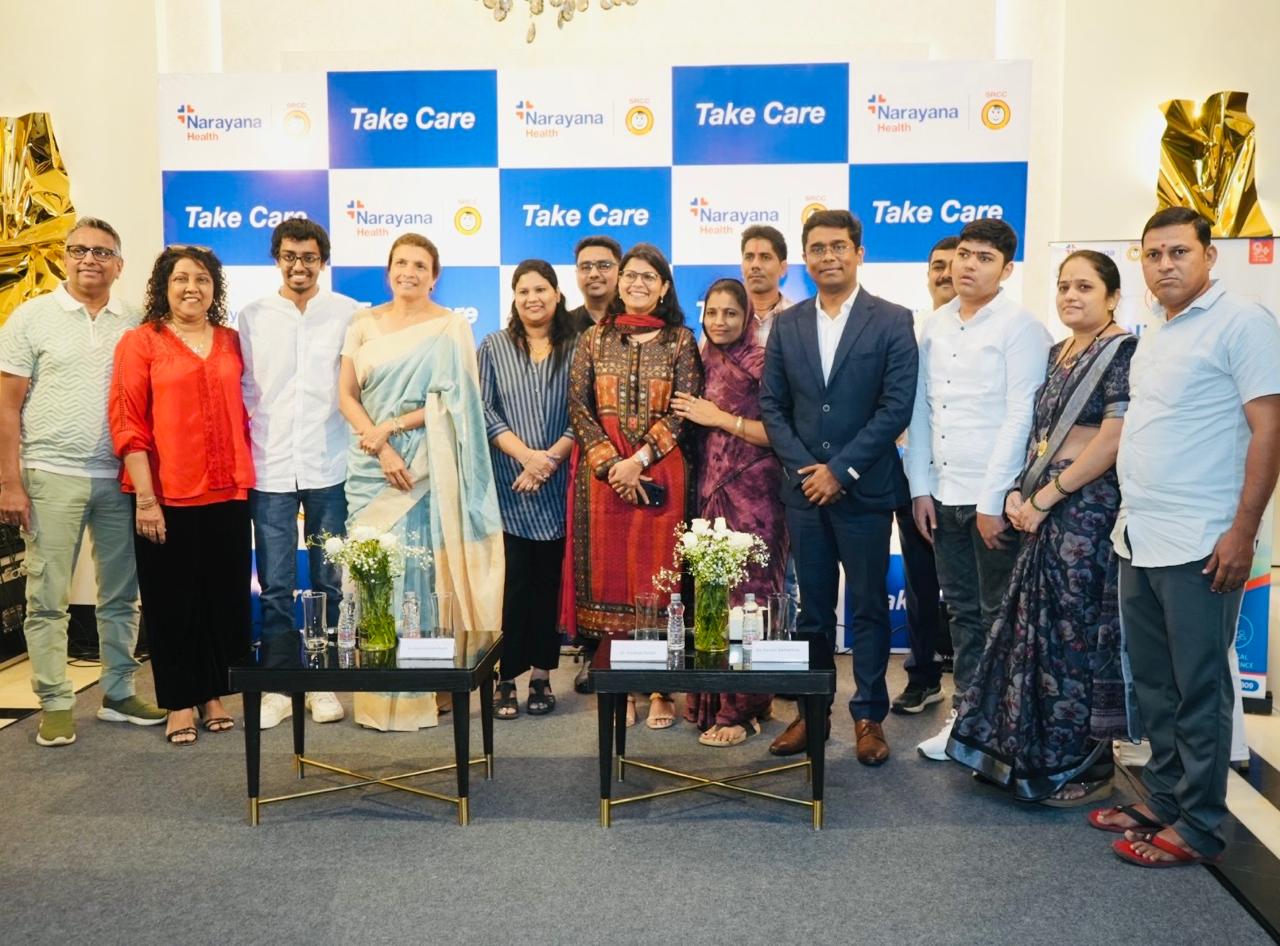
Narayana Health SRCC Children’s Hospital in Mumbai has achieved a major healthcare milestone by completing over 175 successful paediatric epilepsy surgeries—and is rapidly closing in on the 200-mark. As home to India’s largest and only dedicated programme for drug-resistant epilepsy in children, the hospital has delivered an extraordinary 87% seizure-free success rate at a minimum one-year follow-up for curative cases. With an estimated 2 to 3 million people in India living with drug-resistant epilepsy—and only a fraction receiving timely surgical intervention—this landmark achievement highlights the life-changing power of early detection, advanced neurosurgical techniques, and specialized multidisciplinary care.
The Epilepsy programme in Narayana Health SRCC Children’s Hospital was started by a dedicated team of doctors – Dr. Anaita Udwadia Hegde, Head, Neurosciences Department, Dr. Pradnya Gadgil, Senior Consultant Paediatric Neurology and Dr Saurav Samantray, Senior Consultant Paediatric Neurosurgeon with a vision to develop quaternary pediatric neurology subspecialities in India.
Dr Anaita Udwadia Hegde, Head, Neurosciences Department, Narayana Health SRCC Children’s Hospital, said: “The need for comprehensive tertiary paediatric neuroscience services in India has never been greater. Epilepsy is among the most prevalent neurological disorders of childhood, yet access to specialised care remains limited. Complex neurology care cannot be delivered effectively without the backing of a team and infrastructural setup. It requires strong institutional programs where multidisciplinary teams work together supported by specialized infrastructure and a work ethic of protocol-based management.”
Dr Pradnya Gadgil, Head, Complex Paediatric Epilepsy Program, Narayana Health SRCC Children’s Hospital, said: “Uncontrolled childhood epilepsy is a very difficult scenario: apart from frequent seizures which can’t be predicted, they also pose risk to life and limb. The ongoing uncontrolled epilepsy and multiple anti-seizure medications also affect neurodevelopment significantly. These children often surgically remediable epilepsy- where surgery can potentially provide seizure freedom. Identifying them early through meticulous pre-surgical evaluation is critical. Other children could benefit through disease modifying epilepsy surgeries.”
Dr. Saurav Samantray, Senior Consultant, Paediatric Neurosurgery, Narayana Health SRCC Children’s Hospital, said: “Epilepsy surgery means a group of highly specialized neurosurgical procedures – individually selected for each child. Some aim for seizure freedom by removing, disconnecting or minimally invasively ablating the tissue responsible for seizures; others aim to reduce severe seizure burden when cure is unlikely. In appropriately selected children, the benefits can extend beyond seizure cure and control. Often the neurocognitive functioning improves when epilepsy is cured or better controlled. So, the benefits of epilepsy surgery transcend beyond the obvious seizure control. These outcomes are deliverable only from an experienced multidisciplinary epilepsy team, not an individual neurosurgeon alone.”
The following cases from the programme illustrate the range of what timely surgical evaluation can achieve:
A six-year-old boy, Rohan (name changed), had developed daily drop attacks at 2 years of age. Over the next two to three years, he lost the ability to read, write, and interact with other children. After multiple medications failed to control his seizures, he underwent a corpus callosotomy. His drop attacks stopped the very next day. Over the following months, with physiotherapy and occupational therapy, he began reciting poems and writing letters and numbers again.
Pratik (name changed), now in his late twenties, had lived with violent nocturnal seizures since he was three-and-a-half, episodes that woke him and his family through the night for 23 years despite evaluations at multiple centres. A fresh assessment at SRCC identified a congenital brain malformation that had gone undetected for over two decades. He underwent surgery to remove it and had no seizures from the very first night after. Nearly six months on, he remains seizure-free and is back to leading a normal life.
Mithila (name changed), a 10-year-old girl from Ratnagiri had daily seizures since infancy, caused by extensive brain damage sustained before birth, and had been told by other centres that little could be done. She underwent a hemispherectomy, disconnecting the damaged hemisphere from the healthy brain, despite the risk of worsening her existing right-sided weakness. Three months on, she is completely seizure-free and, with rehabilitation, is walking independently and speaking for the first time.
Raj (name changed), 12, had a brain injury at birth that initially didn’t stop him from achieving his developmental milestones- he was even playing football by age four. But worsening seizures and a deteriorating EEG left him nearly bedbound and non-verbal. His surgery was delayed nearly a year due to low awareness of the treatment options. Following corpus callosotomy, his drop attacks stopped completely; six months on, he is walking independently and speaking in sentences.
Sonam (name changed), a five-and-a-half-year-old girl had daily “laughing seizures” caused by a rare hypothalamic hamartoma, a lesion deep in the brain carrying a high risk of serious complications if accessed by traditional open neurosurgical techniques. She underwent stereotactic radiofrequency ablation, a minimally invasive procedure, and was awake and feeding within hours with no complications. Her seizures stopped completely.
With 175+ paediatric epilepsy surgeries performed in 3.5 years, the experience reinforces a simple message: epilepsy should not be allowed to remain an unspoken condition, particularly when a child continues to have seizures despite medication. In a highly specialised field with few centres in India treating children with drug-resistant epilepsy, this represents significant experience across complex cases.
As SRCC continues to bridge India’s critical treatment gap in paediatric neurology, increasing public awareness and timely referrals remain the most crucial steps in helping children break free from uncontrolled seizures and step into a brighter, healthier future.