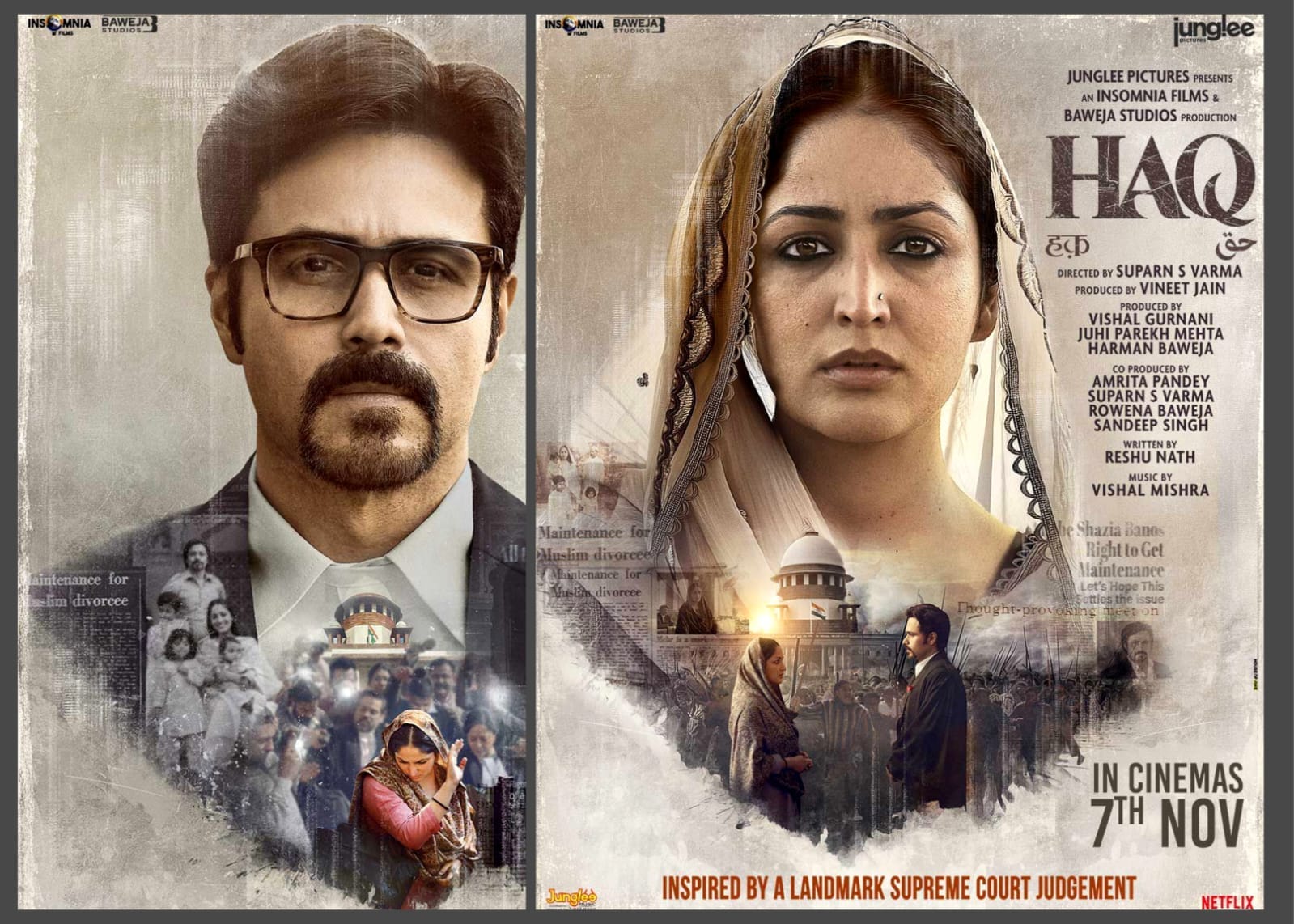
The Film releases in theatres November 7, 2025

There’s something profoundly powerful about Haq. It’s not a film that shouts for attention — it whispers its truth, and those whispers echo long after the lights dim.
Inspired by journalist Jigna Vora’s book ‘Bano: Bharat Ki Beti’ and the historic Shah Bano case, Suparn Varma’s Haq transforms one of India’s most significant legal battles into a deeply human story of a woman reclaiming her dignity in a system designed to silence her.
A Case That Changed the Course of India
In 1978, 62-year-old Shah Bano went to court seeking maintenance from her affluent lawyer husband, Mohammad Ahmad Khan. What followed was a legal battle that culminated in the 1985 Supreme Court judgement — a landmark moment for divorced Muslim women in India. The verdict upheld maintenance as not merely a legal responsibility but an act of humanity.
Coming at a time when India was already in socio-political flux, the judgement ignited fierce debates on secularism, Muslim personal law, gender justice, and the Uniform Civil Code. The pushback was so intense that it led to a political course correction — one that reshaped the country’s social and political landscape for decades to come.
The Story of Shazia Bano: A Fight for ‘Haq’
Haq mirrors this spirit through the fictional yet painfully real story of Shazia Bano (Yami Gautam Dhar) — a gentle, uneducated woman married to Abbas Khan (Emraan Hashmi), a respected advocate. Their marriage begins with warmth but slowly crumbles under the weight of ego and entitlement.
When Abbas brings home a second wife, Shazia’s world fractures. Her mother-in-law advises her to “adjust,” and for a while, she does — until she can’t. Shazia eventually leaves with her children. Abbas sends maintenance briefly before cutting it off and ending the marriage with three words that carry centuries of pain: talaq, talaq, talaq.
A Film of Restraint, Not Rhetoric
Where Haq triumphs is in its restraint. Varma refuses to sensationalise the issue or use it as propaganda. In a time when films have often used faith as a polarising weapon, Haq stands apart — compassionate, authentic, and courageous in its quietness.
The detailing is immaculate — from the earthy Lucknow homes and realistic courtrooms to the unadorned dialogues far removed from the ornate “Muslim social” genre. The film never panders to stereotypes or loud emotional appeals; instead, it builds its power from truth and tenderness.
Performances That Speak Volumes
Yami Gautam Dhar delivers one of her most moving performances yet — as a woman torn between love, faith, and justice. Her portrayal of Shazia is graceful yet unyielding, commanding empathy without theatrics. Emraan Hashmi, in a career-redefining role, plays Abbas as complex and conflicted — a man both privileged and trapped by patriarchy. The supporting cast — Danish Hussain as Shazia’s compassionate father, Sheeba Chaddha as her lawyer, Aseem Hattangady as her aide, and Vartika Singh as the second wife — all bring authenticity and layered emotion to their roles.
Music & Score: Subtle, Stirring, and Soulful
The film’s haunting yet minimal score perfectly complements its emotional intensity. Vishal Mishra’s compositions and Kaushal Kishore’s heartfelt lyrics add depth without distraction — particularly the soulful track “Qubool” sung by Armaan Khan. The background score by Sandeep Chowta is understated yet evocative, heightening key moments while allowing silence to speak when words fall short.
The Larger Lens
The absence of shrillness defines Haq. Yet, one can’t help but wonder what the film might have been if it had widened its frame to include the broader socio-political repercussions of the Shah Bano verdict — the protests, the legal debates, the government’s capitulation. But perhaps restraint was necessary in these censorious times.
In a subtle post-credit nod, Haq acknowledges the current legal ban on triple talaq, bridging past struggles with present reform — a reminder that progress, however slow, continues.
A Universal Story of Rights and Resilience
While Haq is deeply rooted in India’s cultural soil, its resonance is universal. Across the world, women still struggle to be heard — within laws, faiths, and families. Shazia’s story becomes a symbol for every woman fighting not for privilege, but for dignity — her haq.
Final Verdict
Haq doesn’t thunder, it moves like a quiet storm — stirring, sincere, and steadfast in purpose. It’s a film that understands that true revolutions don’t always arrive with fanfare; sometimes, they begin with one woman choosing not to be silent anymore.
⭐ Rating: 4.5 / 5
A must-watch — an emotionally intelligent, socially relevant, and globally resonant film that reclaims what’s rightfully hers: Haq.
Watch Trailer here….

1 comment
Must watch. Excellent movie.