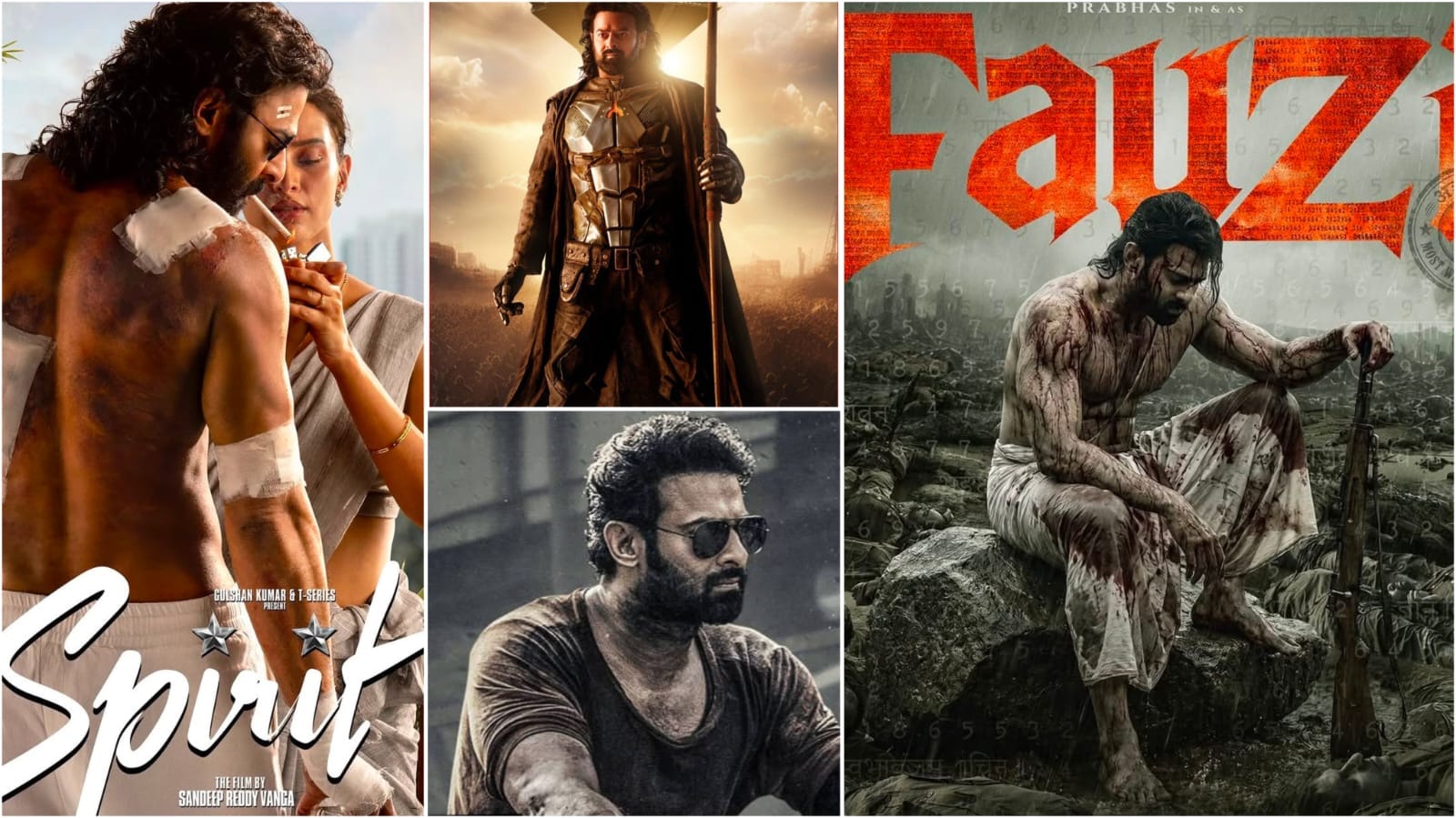
There is a particular kind of silence before a Prabhas film arrives. Not the quiet of absence, but the hush of anticipation — the kind that builds across languages, states, and time zones until a single name becomes a date on every calendar. The queues form before the trailer drops. The conversations begin before the poster releases. And somewhere in the middle of it all, the man himself remains still — working, training, waiting for the moment when the screen finally lights up.
Prabhas does not do small. He does not do rushed. He does not do forgettable.
What he does — consistently, deliberately, at a scale few dare attempt — is cinema that demands the biggest screen in the room. And right now, he has four such films in motion, each one a bet on the idea that Indian audiences will still show up for stories worth waiting for.
The first of these is Kalki 2898 AD: Part 2, Nag Ashwin’s mythological sci-fi universe where faith meets futurism and destiny is not a concept but a force of nature. The first part opened a door no Indian film had walked through before — a 6,000-year-old prophecy rendered in chrome and dust, with Prabhas as the dark, complicated centre of it all. The second part promises to deepen that mythology, to answer the questions the first deliberately left hanging, and to remind audiences that Indian cinema can build worlds as ambitious as anything Hollywood has attempted.
Then there is Salaar: Part 2 – Shouryaanga Parvam, the continuation of Prashanth Neel’s brutal, beautiful action saga. Neel made a star of excess with KGF, but Salaar gave him something else — an actor willing to match that excess with stillness, to let the violence speak through silence rather than noise. The second part will delve deeper into loyalty as prison, power as inheritance, the cost of brotherhood that cannot be paid in blood alone. For fans of the first, this is not a sequel. It is a reckoning.
Spirit, with Sandeep Reddy Vanga, takes Prabhas into territory he has not fully explored — the moral complexity of the cop who becomes what he hunts. Vanga does not make comfortable films. Animal divided audiences precisely because it refused to comfort them. Spirit promises the same unflinching intensity, the same question of whether justice and obsession are ever truly separate. Prabhas as a man in uniform, wrestling with ethics that no rulebook can resolve, is a prospect that should unsettle in the best way.
And finally, Fauzi, with Hanu Raghavapudi, brings him to period military drama — patriotism without jingoism, duty as love, sacrifice that leaves no monument. This is the oldest kind of story, retold through a director known for emotional restraint rather than spectacle. It suggests that even after Kalki and Salaar, Prabhas is still looking for new muscles to stretch.
Four films. Four directors. Four completely different worlds. One actor willing to inhabit them all.
What connects them is not genre or scale, though both vary enormously. It is patience. Prabhas could release two films a year. Many stars do. But the Rebel Star — a title earned, not inherited — has built a career on the understanding that in an era of streaming abundance, the cinema hall must offer something that cannot be paused, cannot be multitasked, cannot be diminished by a smaller screen. Each project demands years, not months. Pre-production that spans continents. Sets that become cities. Action sequences that require training regimens, not choreography shortcuts.
This is theatrical mathematics, and Prabhas has always been good at the numbers. Baahubali redefined what Indian cinema could look like. Salaar proved the pan-India action film had new grammar. Kalki 2898 AD opened a universe no one had attempted at this scale. The next four are not sequels to that success. They are evidence that he is still building.
The directors he has chosen say something too. Nag Ashwin brings world-building precision and mythological depth. Prashanth Neel brings raw action grammar and emotional scale. Sandeep Reddy Vanga brings moral complexity and the courage to divide. Hanu Raghavapudi brings period authenticity and the restraint to let silence work. These are not safe choices. They are bets on vision, on directors who will make Prabhas work harder rather than look better.
And perhaps that is the real story here. At 44, with a filmography that already includes what most actors never attempt, Prabhas has chosen four more mountains. Not because he needs to. Because he believes the audience still wants the climb.
Indian cinema is at an inflection point. Theatrical attendance is recovering but fragile. Streaming has trained audiences to expect immediacy. Stars who once guaranteed openings now struggle to fill opening weekends. Prabhas is the exception that tests the rule. His name on a poster still creates queues. His films still trend before trailers drop. The question is not whether audiences will show up — it is whether the films will justify the faith.
Kalki 2898 AD: Part 2 is expected next. Then Salaar: Part 2. Then Spirit. Then Fauzi. Each one a separate event, a separate reason to return to the hall, a separate argument that the big screen still matters. For fans, this is not a slate. It is a calendar of commitment — from an actor who asks for patience, and rewards it with scale.
The Rebel Star is not chasing relevance. He is building legacy, one theatrical spectacle at a time. And for Indian cinema lovers, that is the best kind of long game.
Prabhas Upcoming Films
Release dates to be announced. Follow GlobalNewsmakers.in for updates.