India’s women’s cricket has entered a transformative phase. After scripting history with their maiden ICC Women’s ODI World Cup triumph, the focus has now firmly shifted to the next big frontier—the ICC Women’s T20 World Cup 2026 in England & Wales. Confidence is high, expectations are rising, and experts believe the timing could not be better for India to finally lift the T20 crown.
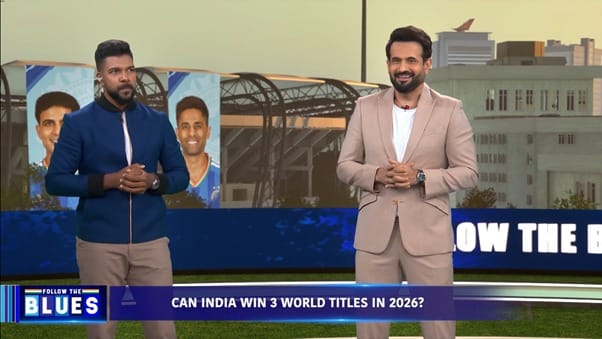
Speaking on ‘Follow The Blues’, JioStar experts Irfan Pathan and Varun Aaron analysed how belief, depth, and the growing impact of the TATA Women’s Premier League (WPL) have reshaped the Indian women’s team into genuine title contenders across formats.
Why the TATA WPL Could Be India’s X-Factor at the Women’s T20 World Cup 2026
Reflecting on India’s breakthrough ODI World Cup win, Varun Aaron highlighted the psychological shift that has changed the team’s mindset, particularly after overcoming their long-standing challenge against Australia.
“Australia used to be India’s bogey team, but once the women went past them in that final and then went on to win the title, it felt like a barrier had truly been broken,” Aaron said.
According to him, that moment has unlocked a new level of belief within the squad.
“Now, with that hurdle crossed, this group will feel they can achieve anything. The momentum around the Indian women’s team, the support from fans, and the backing from the BCCI all give them a great chance to finally win a T20 World Cup—though Australia will definitely be hungry for revenge.”
Former India all-rounder Irfan Pathan, meanwhile, believes India’s biggest advantage lies in the depth created by regular high-quality competitive cricket—something that has been amplified by the WPL.
“Girls now play a lot more cricket, and that depth gives the team plenty of options, especially if injuries crop up, because you have ready-made backups,” Pathan noted.
Highlighting how dramatically the ecosystem has evolved, he added:
“This current pool of players is something you simply didn’t see ten years ago.”
Pathan also pointed to the strategic timing of the TATA WPL, calling it a decisive factor heading into the global tournament.
“The biggest advantage is that WPL comes right before the World Cup, so they go in with both game time and confidence.”
With players entering the World Cup match-hardened and in form, the shift from domestic league to international tournament becomes far less daunting. Pathan further dismissed concerns about switching formats, underlining the team’s improved power game and adaptability.
“Winning a World Cup in one format and then shifting to another is not a big hurdle anymore, particularly with how much their power game has improved,” he said, adding that quick adaptation to English conditions will be key to success.
As preparations intensify for the Women’s T20 World Cup 2026, Indian women’s cricket finds itself at a rare moment of alignment—confidence from recent success, depth built through the WPL, and unwavering institutional support. If momentum holds and conditions are negotiated smartly, this team may well be poised to script yet another.
