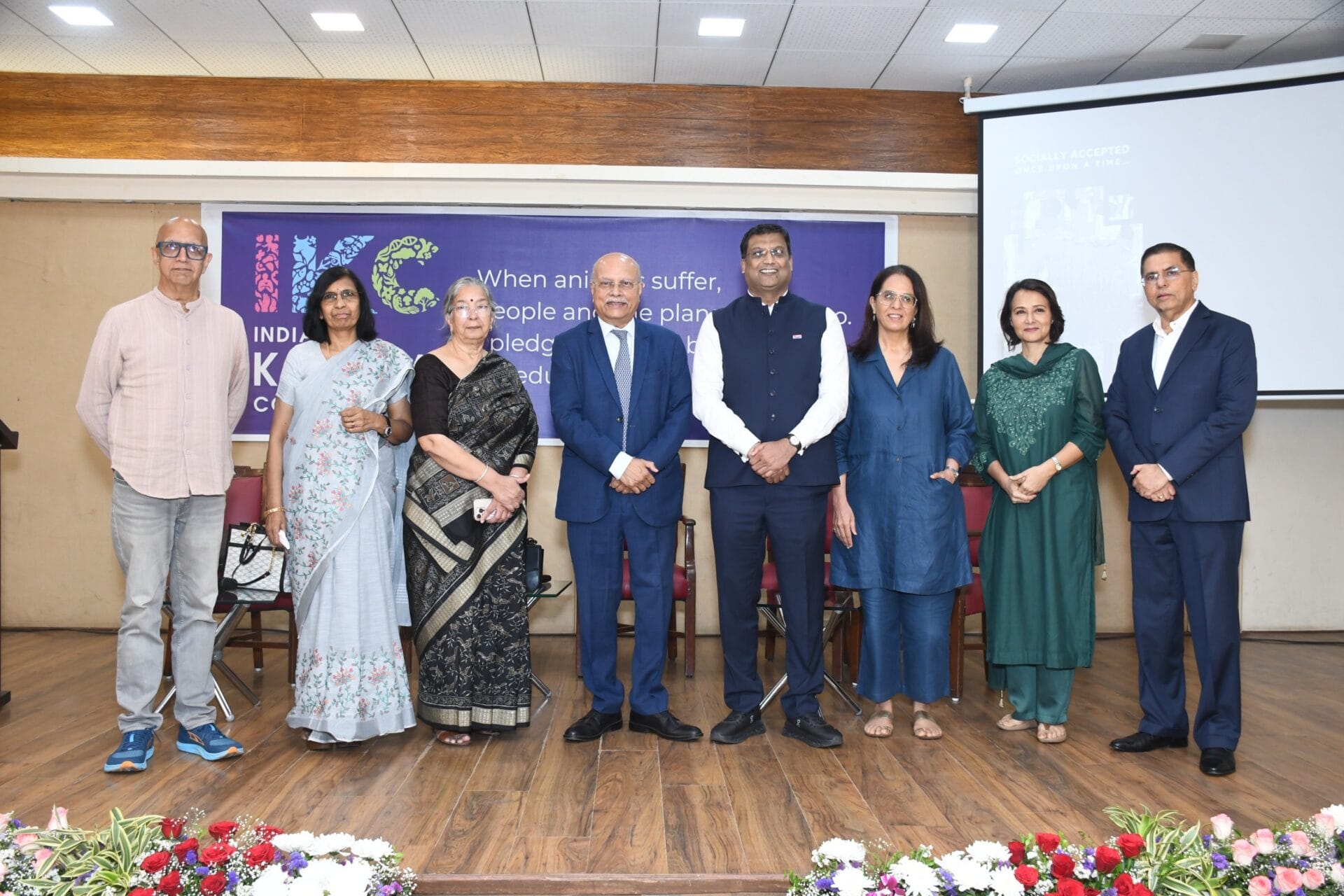
India Karuna Collaborative (IKC) and farmed animal welfare took center stage today in Mumbai as over 70 leaders launched a first-of-its-kind national platform to address the invisible crisis within our food systems. With over 1.5 billion farm animals embedded in India’s daily economy, these populations have long remained absent from critical policy frameworks and measures of national progress. By integrating animal welfare into India’s climate, public health, and economic development agenda, the IKC aims to reform modern food systems and bring visibility to the unseen cruelty that currently underpins them within the One Health, One Planet framework.
More than 50 organisations and over 70 leaders from business, science, public health, and civil society have united as part of IKC, convinced that this invisible population represents a missing — and critical — dimension in the country’s development story.
“IKC is not asking India to simply “care more.” It is asking India to design better — so that care becomes embedded in how we produce, consume, regulate and innovate. Over the years, whether in business or philanthropy, I’ve come to believe that purpose is not a slogan. Purpose is a discipline. It changes what you invest in, what you measure, and what you build,” said Harsh Mariwala, founder and chairman of Marico and mentor to IKC, who delivered the keynote address, in the context of building markets and products that make humane choices easier, affordable and mainstream.
A position paper, The Interconnected Crisis: Animal Welfare, Human Health, and Climate Change in India, released at the launch, established the interlinkages at the root of food systems that have evolved without recognising animals as sentient beings.
“What makes this interconnected crisis so hard to address is that so much of it is invisible by design. We measure the output of milk, eggs, meat, but we don’t measure pain. And yet, the scale of the pain is staggering: India’s farmed animal population includes hundreds of millions of hens and bovines, millions of goats, sheep, pigs, — and trillions of fishes,” said Motilal Oswal, founder and managing director of Motilal Oswal Financial Services Limited and mentor to IKC.
New data released on the occasion shows that the public is already ahead of the curve. A nationally representative 2026 survey commissioned by IKC, They Feel, We Care: Young India’s Attitudes to Farmed Animals, their Welfare and Plant-Forward Eating, found that 70% of participants believe farmed animals are sentient beings who experience suffering. It also found that 69% of dairy consumers and more than 50% of meat and egg consumers are willing to pay 10% or more for products with higher animal welfare standards, and that 53% are open to replacing some or all animal protein with plant-based options.
“Today’s Indian consumer is informed, discerning, and values driven. They believe animals feel, they seek transparency in production, and they expect brands and governments to lead in elevating welfare standards across supply chains,” said Edward Hutasoit, General Manager (India & Indonesia), YouGov, the research provider for the survey.
The launch concluded with a high-level panel discussion — One Health. One Planet. One Economy. One Blind Spot — moderated by Mehak Kasbekar, VP and Editor-in-Chief of Brut India. The panel brought together Dr Hemalatha R, former Director of ICMR National Institute of Nutrition; Amala Akkineni, founder of Blue Cross of Hyderabad; Gauri Maulekhi, trustee of People for Animals; and Sanjiv Mehta, Executive Chairman of L Catterton India.
Expert Perspectives: The Business and Ethical Case for Reform
Mr. Sanjiv Mehta, Executive Chairman, L Catterton India: “As meat production and antibiotic use rise, the economic and public health costs could be staggering. Businesses must build supply chains with purpose—applying the same ethics, transparency, and sustainability we bring to our brands. Ultimately, a healthy society and a resilient ecosystem are fundamental to long-term commercial success.”
Ms. Amala Akkineni, Founder, Blue Cross of Hyderabad: “The challenges we face—from animal suffering to environmental strain—are deeply interconnected and cannot be solved in isolation. At the heart of the problem is an exploitative approach toward nature. Initiatives like the India Karuna Collaborative are vital because they bring these conversations to the forefront, encouraging us to rethink how we coexist with animals and the planet.”
Ms. Gauri Maulekhi, Trustee, People for Animals: “How we raise animals for food is inextricably linked to human health. With nearly 70% of global antibiotics used in animal agriculture, intensive farming is accelerating antimicrobial resistance and the emergence of deadly superbugs. While this system keeps costs low, the long-term price is far higher. This crisis has been acknowledged at the highest levels of government, yet it still lacks the urgent attention it deserves.”
The launch of the India Karuna Collaborative marks a pivotal moment where compassion meets commerce and policy. By acknowledging the 1.5 billion lives at the heart of our food systems, India has the opportunity to lead a global shift toward a more ethical, resilient, and sustainable future for all.
The IKC Pledge:
“I believe that animals are sentient beings and that human, animal, and planetary well-being are interconnected. When animals suffer, people and the planet suffer too. I pledge to do my best to reduce animal suffering.”
