On opening day, Christopher Nolan’s mythic epic doesn’t just adapt Homer — it makes you feel every wave, every wound, and every whispered prayer to get home.
“Tell me, Muse, of the man of many devices, who wandered full many a way after he had sacked the sacred citadel of Troy…”
Homer does not open with triumph. He opens with the cost of it — a man so clever he outwitted a city, yet so lost he cannot find his way home. And Nolan hears every word.
Part One: Into the Storm — The Voyage That Swallows You Whole
When the house lights dim and that first wave crashes against the screen — not just any wave, but a wall of water so immense it feels like it might spill over the edge and soak your shoes — you realize within seconds that Christopher Nolan has done it again. Only this time, he hasn’t just built a world. He has dropped you inside it, salt spray and all.
The Odyssey, brought to life with staggering ambition by Universal Pictures, is the kind of film that doesn’t ask for your attention. It seizes it. And then it refuses to let go for every single one of its 173 minutes. Based on Homer’s ancient epic, yes — but Nolan treats the source material not like a museum piece under glass, but like a living, breathing thing. He takes a story most of us skimmed in school and makes it pulse with the same urgency as a heartbeat in your throat.
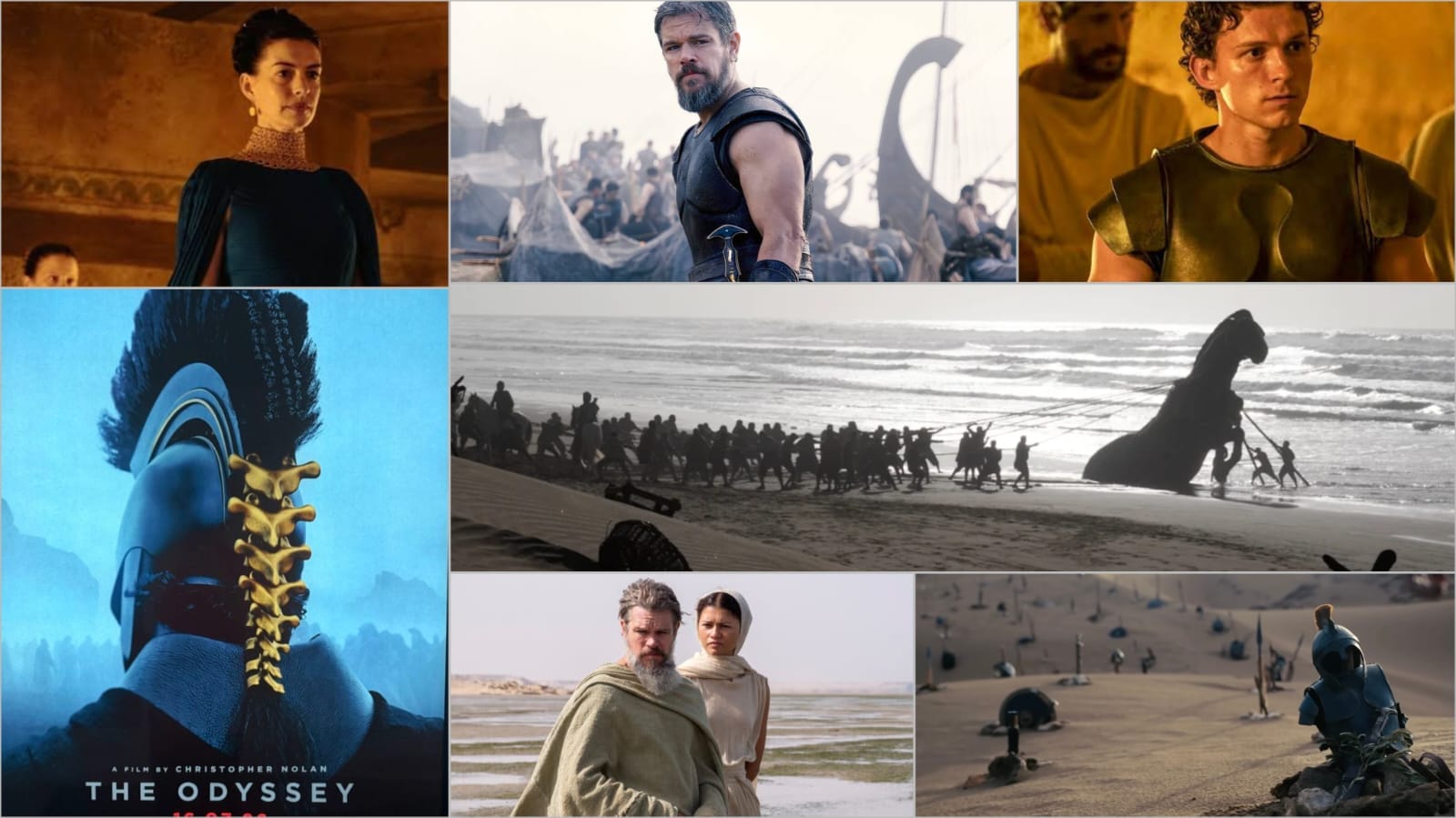
And before we even meet the man adrift at sea, the film takes us back to where it all began — to the moment that made Odysseus a legend long before he became a wanderer. The Trojan Horse. In Greek mythology, this was the stroke of genius that only a mind like Odysseus could conceive: a massive hollow wooden horse, built by the master carpenter Epeius, left behind as an offering to the goddess Athena. The Greeks planted a soldier named Sinon to convince the Trojans to wheel the horse inside their walls. Despite the desperate warnings of the priest Laocoön, the Trojans fell for the ruse. And under the cover of night, Odysseus and his elite warriors emerged from the belly of the beast, threw open the gates, and let the Greek army pour in to sack Troy. It is one of the most brilliant acts of deception in all of storytelling — and it is entirely Odysseus’s doing. Nolan doesn’t just mention this in passing. He shows us the weight of it. The cunning. The ruthlessness. The cost. You watch Odysseus orchestrate the fall of a city not with a sword, but with a mind sharper than any blade, and you understand immediately why the gods would both admire and punish such a man. This is not a warrior who wins through brute force. This is a man who outthinks everyone in the room — and that same mind, that same restless, scheming intelligence, is what will both save him and haunt him across the ten years to come.
Picture this: You are standing on the deck of a ship as the Ionian Sea rises around you, the sky splitting open with thunder that you don’t just hear in the speakers — you feel it in your chest. The camera, shooting entirely on 65mm IMAX film, doesn’t just show you Odysseus’s journey. It straps you to the mast beside him. When the Cyclops roars, you flinch. When the sirens sing, you lean forward without meaning to. When the waves crash and the men scream and the wood splinters beneath their feet, you grip your armrest because some part of your brain has forgotten you’re sitting in a theatre in Mumbai or Delhi or Chennai. You are there. Drowning in it. Surviving it.
And that is the real magic of this film. It isn’t just the monsters or the gods or the battles — though all of those are rendered with a scale that will leave your jaw slack. It is the way Nolan makes you feel the weight of every single day of that ten-year voyage. You feel the salt crusting on skin that hasn’t seen fresh water in months. You feel the hollow ache of a stomach that has forgotten what a full meal tastes like. You feel the gnawing, desperate loneliness of a man who has everything and nothing, who has conquered Troy only to find that the real war is the one raging inside his own head.
Matt Damon plays Odysseus not as the polished hero of storybooks, but as a man unraveling at the edges. His eyes carry the thousand-yard stare of someone who has seen too much, done too much, and is terrified that the person he was when he left Ithaca no longer exists. When he whispers Penelope’s name in the dark of a cave, it isn’t romantic — it is desperate. It is a prayer. And you feel that desperation in your own throat.
Part Two: The Reckoning — What We Carry Home
But a journey means nothing without a home to return to. And it is in Ithaca — in the crumbling halls, the whispered conspiracies, the unspoken grief — that the film finds its truest, most devastating power.
Anne Hathaway’s Penelope is no passive wife waiting by the window. She is a fortress. Every glance she casts at the suitors circling her throne is a chess move. Every stitch she unpicks at night is an act of quiet rebellion. You don’t just admire her — you want to stand up and cheer for her. When she finally stands face to face with the husband she hasn’t seen in twenty years, the moment doesn’t explode. It trembles. It is two people recognizing each other across an ocean of time, and it will wreck you in the best possible way.
Tom Holland’s Telemachus, meanwhile, is all jagged edges and barely contained fury, a boy who has had to become a man in a court that reeks of wine and lies. When he finally stands shoulder to shoulder with his father, it isn’t just a reunion. It is a reckoning. And it will wreck you.
The supporting cast is just as devastating. Robert Pattinson’s Antinous doesn’t swagger — he slithers. He is the kind of villain who smiles while he twists the knife, and Pattinson plays him with such oily charm that you understand exactly why the suitors follow him, even as your skin crawls. Charlize Theron’s Calypso is heartbreaking in her loneliness, a goddess who has everything except the one thing she wants, and her island paradise feels less like a prison for Odysseus and more like a gilded cage for her. Lupita Nyong’o, Samantha Morton, Himesh Patel — every single performance is a world unto itself, a fully realized human being with desires and fears and flaws that mirror our own.
But what stays with you, long after the credits roll and the lights come up, is the way this film makes you question your own life. Nolan doesn’t just retell an ancient story — he holds it up like a mirror and asks: What are you wandering toward? What have you sacrificed to get there? Is the person you are now someone your younger self would recognize? The film is heavy with these questions, but it never lectures. It simply presents the human condition in all its messy, glorious, heartbreaking complexity and trusts you to sit with it.
You see the corrosive rot of jealousy and selfishness as Ithaca’s court crumbles from within. You see the blinding hunger for victory that drives men to do terrible things, and the hollow silence that follows when they realize the cost. But you also see the redemptive power of love that refuses to die, of loyalty that outlasts every storm, of a family that holds together not because it is perfect, but because it is theirs.
And then there is the sheer, overwhelming beauty of it all. The way the light breaks over the Aegean at dawn. The way the stars wheel overhead in a sky so vast it makes you feel small and significant at the same time. The way a single tear tracks down Penelope’s cheek in a shaft of golden afternoon light. Nolan and his cinematographer have crafted images that don’t just deserve to be seen on the biggest screen possible — they demand it. This is why the film has been released across India in English, Hindi, Tamil, and Telugu, because a story this universal deserves to reach every corner of a country that knows a thing or two about epic journeys and homecomings.
So yes — go see The Odyssey. Go see it on the biggest, loudest, most immersive screen you can find. Go see it with people you love, because you will want to talk about it for hours afterward. Go see it because in an age of disposable entertainment, this is a film that matters. It is a film that reminds us why we tell stories in the first place: not to escape our lives, but to understand them.
Christopher Nolan hasn’t just adapted Homer’s epic. He has breathed new life into it, made it beat with a heart that is unmistakably, unapologetically human. And when that final frame fades to black, you won’t just walk out of the theatre. You will carry something out with you. A question. A feeling. A memory of what it means to be alive, to be lost, to be searching, and — finally — to find your way home.
Watch the official trailer of Christopher Nolan’s The Odyssey here, and let it be the compass that points you toward one of the most immersive cinematic experiences of our time.
▶ Watch the Official Trailer

2 comments
[…] ALSO READ : The Architecture of the Human Soul: Why Christopher Nolan’s The Odyssey is Far More Than a Myt… […]
[…] ALSO READ : The Architecture of the Human Soul: Why Christopher Nolan’s The Odyssey is Far More Than a Myt… […]