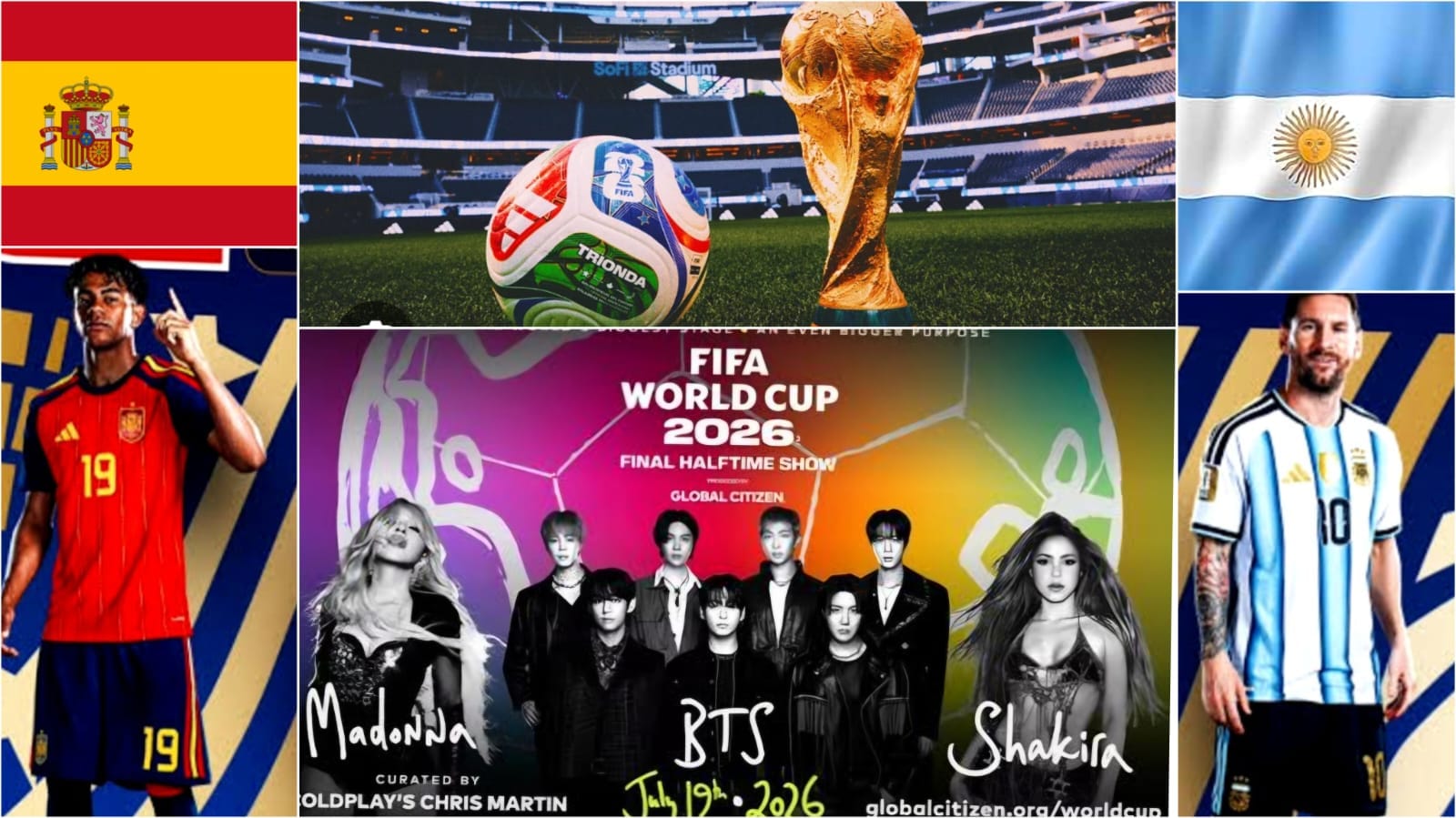
As FIFA prepares to stage its first-ever halftime show during a World Cup Final, the biggest story may not be the star-studded lineup—it may be how these 11 minutes redefine the intersection of sport, music, culture and global purpose.
There is a singular kind of magic in sport—one that has the extraordinary ability to make billions of people stop what they’re doing, hold their breath, and collectively live a single moment together. On Sunday, July 19, 2026, that shared heartbeat will echo louder than ever before.
When the referee blows the whistle for halftime at New York New Jersey Stadium (MetLife Stadium), the world’s biggest football match will pause—not simply for a break in play, but for a moment that promises to reshape the very identity of the FIFA World Cup Final. For the first time in the tournament’s nearly century-long history, FIFA is introducing a Super Bowl-style halftime show.
For decades, the FIFA World Cup Final has belonged entirely to football. Unlike the NFL’s Super Bowl, where halftime entertainment has evolved into a global spectacle in its own right, football’s biggest stage has traditionally resisted blending sport with mainstream entertainment. That changes in 2026—and with it, perhaps, the future of how the world experiences its greatest sporting event.
This isn’t merely a concert squeezed into the middle of a football match. It is an ambitious celebration of global culture, human connection and shared purpose—one designed to unite billions of viewers through music while championing a cause far greater than the final score.
The Ultimate Sonic Mashup: 11 Minutes of Pure Global Culture
Trying to capture the musical heartbeat of the planet in just eleven minutes sounds almost impossible.
Yet the lineup curated by Coldplay frontman Chris Martin does exactly that—bringing together artists, orchestras and cultural icons from every corner of the world.
Leading the performance are legendary entertainers Madonna and Shakira, joined by global pop sensation Justin Bieber, K-pop phenomenon BTS, and Nigerian Afrobeats superstar Burna Boy.
Adding an entirely different musical dimension is internationally acclaimed conductor Gustavo Dudamel, performing alongside the New York Philharmonic and the beloved PS22 Children’s Chorus, with a special appearance by Chris Martin himself.
In a delightful reminder that learning begins with imagination, beloved characters from Sesame Street and The Muppets will also take the stage—reinforcing the event’s deeper message of education, hope and opportunity for children worldwide.
From orchestral grandeur and Latin rhythms to Afrobeats, K-pop and contemporary pop music, the performance mirrors the World Cup itself—a celebration of diversity where language, nationality and borders briefly disappear.
More Than Entertainment. A Global Mission.
Behind the dazzling lights, intricate choreography and headline-making performances lies a far more meaningful purpose. Produced by Global Citizen in partnership with Live Nation and Done + Dusted, the inaugural FIFA World Cup Final Halftime Show serves as the launchpad for the FIFA Global Citizen Education Fund—an ambitious initiative designed to harness the unparalleled reach of the world’s biggest sporting event to create lasting social impact. Spearheaded by Global Citizen CEO Hugh Evans, the campaign aims to raise USD 100 million to expand access to quality education and youth football programmes for children across the globe. The momentum has already begun, with more than USD 50 million committed, supported in part by a USD 1 contribution from every ticket sold for the FIFA World Cup 2026. In doing so, FIFA is attempting something rarely seen in global sport—transforming its biggest stage into a platform that not only crowns world champions but also invests in the dreams and futures of millions of children long after the final whistle has blown.
As Hugh Evans aptly puts it, “The FIFA World Cup is the most unifying event on Earth. Together, we wanted to create the first halftime moment in history focused on leaving a lasting legacy for children worldwide.” It is a reminder that while trophies celebrate sporting excellence, true legacy is measured by the lives transformed beyond the stadium.
A New Chapter for the FIFA World Cup
Whether the inaugural halftime show becomes a one-time experiment or the beginning of a new FIFA tradition, one thing is already certain—it marks a defining moment in the evolution of the world’s biggest sporting event. For nearly a century, the FIFA World Cup Final has been celebrated purely for what happened between kick-off and the final whistle. In 2026, history will also be written during the interval.
By bringing together global music icons, a philanthropic mission and one of the largest television audiences on the planet, FIFA is signalling that the modern World Cup is no longer just a football tournament. It is a global cultural platform capable of shaping conversations that extend far beyond the pitch. If successful, these eleven minutes may well become the blueprint for future World Cup Finals, forever changing how billions experience the beautiful game.
So, when the referee blows the whistle for halftime on July 19, resist the temptation to walk away from the screen. Those eleven minutes are about far more than celebrity performances or stadium entertainment. They represent the meeting point of sport, music, philanthropy and global culture, all unfolding before one of the largest audiences in human history. Because history is not always written in the ninety minutes that decide a champion. Sometimes, it is written in the eleven minutes that remind the world why we come together in the first place.
Before You Tune In: FIFA World Cup 2026 Final – Time & Viewing Guide
📅 Match Date (USA): Sunday, July 19, 2026
📍 Venue: New York New Jersey Stadium (MetLife Stadium), East Rutherford, New Jersey, USA
🕒 Kick-off Time (USA – EDT): 3:00 PM EDT
🇮🇳 Kick-off Time (India – IST): 12:30 AM IST (Monday, July 20, 2026)
While fans inside the stadium will witness the Final under the afternoon sun in New Jersey, football enthusiasts in India will be settling in during the early hours of Monday morning. Thanks to the 9½-hour time difference, the match kicks off at 12:30 AM IST, making it a late-night (or early-morning!) event for Indian viewers—but one that promises to be worth staying awake for.